
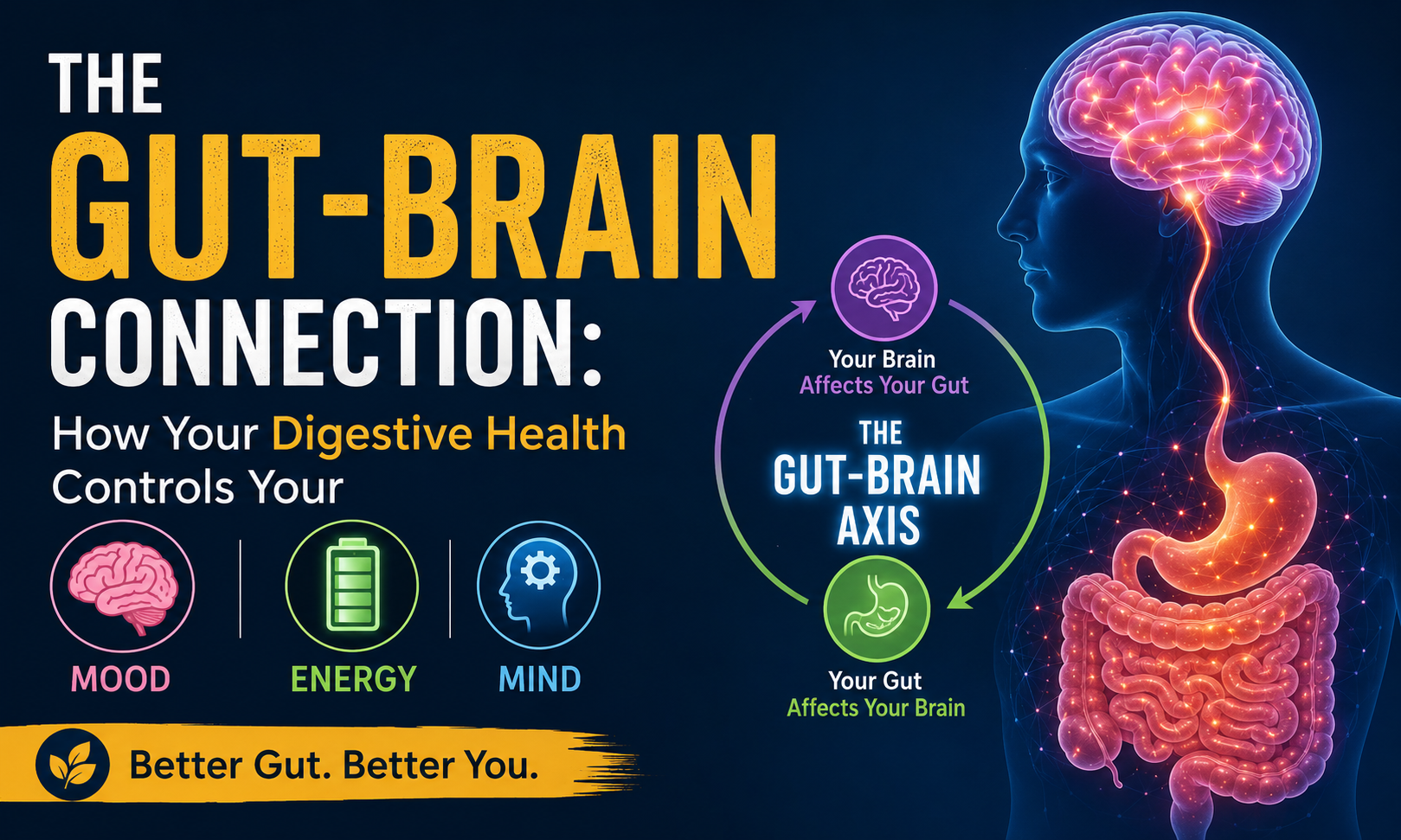
There’s a reason people say they have a “gut feeling” about something. Long before scientists had the language to describe it, we intuitively understood that the gut and the brain were talking to each other. What’s surprised researchers over the past two decades is just how much of that conversation is initiated by the gut — not the brain.
Your digestive system houses roughly 500 million neurons and produces about 95% of the body’s serotonin — the neurotransmitter most closely associated with mood, sleep, and emotional regulation. The gut communicates with the brain constantly through the vagus nerve, the enteric nervous system, immune signaling, and the metabolites produced by your gut microbiome.
This isn’t alternative medicine. It’s mainstream neuroscience, and it has real, practical implications for how you eat, how you feel, and what you can actually do about both.
What Is the Gut-Brain Axis?
The gut-brain axis is the bidirectional communication network connecting your central nervous system (brain and spinal cord) with your enteric nervous system (the nervous system embedded in your gut wall). It operates through several channels simultaneously:
The vagus nerve runs from the brainstem directly to the abdomen and carries signals in both directions — but approximately 80% of the signals travel upward, from gut to brain, not the other way around. This is counterintuitive to most people who assume the brain is doing most of the directing.
The microbiome — the community of trillions of bacteria, fungi, and other microorganisms living in your digestive tract — produces neurotransmitters and short-chain fatty acids that cross into the bloodstream and influence brain function directly. Specific bacterial strains produce GABA, dopamine precursors, and serotonin in amounts that meaningfully affect mood and cognition.
The immune system acts as an intermediary. About 70% of your immune cells live in the gut. When gut barrier integrity is compromised — a condition sometimes called leaky gut — inflammatory signals reach the brain and have been associated with depression, anxiety, and cognitive fog.
The HPA axis (hypothalamic-pituitary-adrenal axis), which governs your stress response, is directly influenced by gut health. Chronic gut inflammation activates stress pathways, and chronic stress in turn disrupts the gut microbiome — a cycle that researchers are increasingly studying as a driver of both physical and mental health conditions.
According to research published at the National Institutes of Health, disruptions in the gut-brain axis are now implicated in conditions ranging from irritable bowel syndrome to major depressive disorder, Parkinson’s disease, and autism spectrum disorder.
Leaky Gut: What It Is and What It Actually Means
“Leaky gut” has become a somewhat polarising term — overused in wellness circles and sometimes dismissed entirely in clinical ones. The more precise term is intestinal hyperpermeability, and the research on it is real and growing.
Your intestinal lining is designed to be selectively permeable — allowing nutrients through while keeping bacteria, toxins, and undigested food particles out of the bloodstream. The barrier is maintained by tight junction proteins that seal the gaps between intestinal cells.
When those tight junctions are damaged or loosened — by chronic stress, a diet high in processed food, heavy alcohol use, certain medications including NSAIDs, or repeated antibiotic courses — the barrier becomes more permeable than it should be.
Leaky gut symptoms that researchers have associated with intestinal hyperpermeability include:
- Bloating, gas, and unpredictable bowel habits
- Food sensitivities that seem to be worsening or multiplying
- Chronic fatigue that doesn’t resolve with rest
- Brain fog, difficulty concentrating, and memory issues
- Skin conditions including eczema and acne
- Joint pain and inflammation
- Mood disturbances — anxiety, irritability, and low mood that don’t have an obvious external trigger
It’s worth noting that leaky gut itself is not a formal clinical diagnosis in most medical systems, and many of these symptoms are shared with other conditions. If you’re experiencing several of them persistently, working with a gastroenterologist or functional medicine physician will give you a clearer picture than self-diagnosis.
The Microbiome: Your Internal Ecosystem
Your gut microbiome is a community of approximately 38 trillion microorganisms — bacteria, viruses, fungi, and other entities — that lives primarily in your large intestine. This community is as unique to you as your fingerprints, shaped by your birth history, diet, medications, geography, stress levels, and even the people you live with.
The diversity of that community matters enormously. Microbiome health — specifically, having a wide variety of bacterial species — is one of the strongest predictors of overall metabolic, immune, and psychological health researchers have found. People with more diverse microbiomes consistently show lower rates of depression, anxiety, obesity, type 2 diabetes, and inflammatory disease.
The key bacterial families most studied for their gut-brain effects include:
Lactobacillus species, which are among the best-studied gut bacteria for mood and anxiety outcomes. Several strains have shown antidepressant-like effects in human trials, primarily through their influence on serotonin and GABA production.
Bifidobacterium species, which are important for immune regulation and have been associated with reduced anxiety and stress reactivity.
Akkermansia muciniphila, which maintains the mucus layer lining the gut wall and supports metabolic health. Lower levels are consistently associated with obesity, inflammatory conditions, and metabolic syndrome.
Faecalibacterium prausnitzii, a major butyrate producer. Butyrate is a short-chain fatty acid that fuels the cells lining the colon, supports the gut barrier, and has anti-inflammatory effects that extend throughout the body.
The Harvard T.H. Chan School of Public Health provides an accessible and clinically grounded overview of microbiome research for anyone who wants to read further into the evidence.
The Gut Health Diet: What to Eat for a Better Microbiome
Diet is the single most powerful tool you have for shaping your microbiome — more impactful than probiotics, supplements, or almost any other intervention. Changes in the gut microbiome community can be detected within 24–48 hours of a significant dietary shift, which means this isn’t a months-long project before you see any effect.
Eat More Fibre — Especially Diverse Fibre
Different bacterial species feed on different types of fibre. Eating a wide variety of plant-based foods ensures you’re feeding a wider variety of bacteria — which is exactly what you want. The target commonly cited in microbiome research is 30 different plant foods per week. That sounds like a lot until you realise that herbs, spices, nuts, seeds, and legumes all count.
High-fibre foods that specifically support beneficial bacteria:
- Legumes — lentils, chickpeas, black beans, and kidney beans
- Oats and barley (contain beta-glucan, a particularly well-studied prebiotic fibre)
- Garlic, onions, leeks, and asparagus (high in inulin, a potent prebiotic)
- Bananas, especially slightly underripe ones (high in resistant starch)
- Jerusalem artichokes, chicory root, and dandelion greens
Fermented Foods
Fermented foods directly introduce live microorganisms to the gut, and a landmark 2021 Stanford study published in Cell found that a high-fermented-food diet increased microbiome diversity and reduced inflammatory markers more effectively than a high-fibre diet alone in adults.
The most accessible fermented foods to incorporate regularly:
- Natural yogurt (live cultures, not heat-treated after fermentation)
- Kefir (higher diversity of bacterial strains than most yogurts)
- Sauerkraut and kimchi (unpasteurised versions from the refrigerated section, not shelf-stable)
- Miso and tempeh
- Kombucha in moderation (watch sugar content in commercial versions)
High Protein Foods and Gut Health
Adequate protein matters for gut health in ways that often get overlooked in microbiome discussions. The intestinal epithelium — the lining of your gut — turns over completely every 3–5 days, and it needs amino acids to do that efficiently.
High protein foods that support gut health specifically include:
- Eggs (also rich in leucine, which supports gut barrier repair)
- Fish — particularly oily fish like salmon and sardines, which also provide anti-inflammatory omega-3 fatty acids
- Legumes — the fibre-protein combination makes them uniquely valuable for gut health
- Nuts and seeds, especially almonds and flaxseeds
If you’re trying to assess whether you’re getting enough protein for your body weight and activity level, a protein intake calculator (Healthline maintains a well-referenced one here) can give you a personalized starting target. Most gut health researchers suggest 1.0–1.2 grams per kilogram of body weight as a minimum for adults.
Polyphenols
Polyphenols are plant compounds found in colourful fruits, vegetables, dark chocolate, green tea, and red wine. They’re only partially digested in the small intestine — which means they arrive in the large intestine where bacteria metabolise them into compounds that support microbiome diversity and have anti-inflammatory effects throughout the body.
Blueberries, dark cherries, pomegranate, green tea, extra virgin olive oil, and dark chocolate (70%+ cacao) are particularly high in polyphenols. The diversity principle applies here too — a variety of colourful plant foods rather than large amounts of any single one.
Best Probiotics: What to Look For
The probiotic market is large and unevenly supported by evidence. Many products make claims far beyond what the research actually shows, so it’s worth knowing what to look for.
What the evidence supports:
Specific strains for specific purposes — not generic “probiotic blends.” The research on probiotics is strain-specific, not species-general. Lactobacillus rhamnosus GG has strong evidence for preventing antibiotic-associated diarrhea and supporting gut barrier function. Bifidobacterium longum and Lactobacillus helveticus together have shown effects on anxiety and depression in clinical trials. Saccharomyces boulardii (technically a yeast) has robust evidence for IBS and traveler’s diarrhea.
CFU count matters less than strain quality — a probiotic with 1 billion CFU of a well-studied strain will outperform one with 50 billion CFU of strains with no clinical evidence.
Survivability through the GI tract — look for products that specify acid-resistant capsules or have been tested for gastric survival. Many probiotic bacteria don’t survive stomach acid in sufficient numbers to colonise the gut unless they’re protected.
The Cleveland Clinic provides a straightforward clinical overview of probiotic evidence that’s worth reading before purchasing any supplement.
When food beats supplements: For most healthy adults, getting probiotic bacteria from fermented foods is more effective than supplements — partly because fermented foods contain a wider variety of organisms, partly because they arrive with prebiotic substrates that help the bacteria survive, and partly because the food matrix itself supports colonisation in ways that supplements can’t replicate.
Supplements become more clearly useful in specific situations: after a course of antibiotics, for specific diagnosed conditions like IBS or pouchitis, or for people who genuinely don’t consume fermented foods.
Foods That Damage the Gut-Brain Axis
The gut-brain connection works both ways — what damages gut health also tends to affect mental health over time. The most reliably harmful dietary patterns for microbiome health:
Ultra-processed foods — products with long ingredient lists containing emulsifiers, artificial sweeteners, and preservatives. Emulsifiers in particular (like carboxymethylcellulose and polysorbate-80, common in packaged foods) disrupt the mucus layer in the gut and have been associated with increased intestinal permeability in research settings.
Artificial sweeteners — several studies, including a 2022 Cell paper, have shown that common artificial sweeteners including sucralose, saccharin, and aspartame alter gut microbiome composition in ways that may impair glucose regulation. The research is ongoing, but the pattern is consistent enough to take seriously.
Chronic high alcohol intake — disrupts the gut barrier directly, reduces microbiome diversity, and promotes the growth of pro-inflammatory bacterial species over beneficial ones.
High-sugar, low-fibre diets — feed pathogenic bacteria and yeasts at the expense of beneficial species that require complex carbohydrates to thrive.
Practical Steps to Start Today
The gut-brain connection is well-established, but acting on it doesn’t require an overhaul. These changes, built gradually, produce measurable effects on microbiome diversity within weeks:
Week 1: Add one fermented food daily. A pot of natural yogurt at breakfast, a tablespoon of sauerkraut with lunch, or a glass of kefir counts. Consistency matters more than quantity.
Week 2: Add one new plant food to your diet. Swap your usual snack for a different fruit or vegetable. Variety is the goal — the same ten plants repeatedly is less beneficial than a rotating thirty.
Week 3: Reduce ultra-processed food by one meal. Cook from ingredients rather than packets three times a week where you currently don’t.
Week 4: Address sleep. Sleep deprivation is one of the most significant disruptors of gut microbiome composition — shifting bacterial populations toward inflammatory species within days. Seven to nine hours of consistent sleep is genuinely part of a gut health protocol.
Notice how you feel mentally. Many people report that improvements in gut health — reduced bloating, better digestion, more consistent energy — come alongside clearer thinking, more stable mood, and reduced anxiety. This isn’t placebo. It’s the gut-brain axis working as it should.
The Bottom Line
Your gut is not just a digestion machine. It’s an active participant in your immune function, your mood regulation, your stress response, and your cognitive performance. The microbiome health research of the past decade has fundamentally shifted how clinicians understand the relationship between what we eat and how we think and feel.
The practical implications are genuinely good news: the most powerful interventions for improving the gut-brain axis are dietary, and most of them are accessible and affordable. More plants, more variety, more fermented foods, less processed food. Those four principles, applied consistently, produce real change — in the gut, and by extension, in the brain that listens to it.
References: NIH — Gut-Brain Axis Review | Harvard School of Public Health — The Microbiome | Cleveland Clinic — Probiotics | Healthline — Gut Health Diet | Verywell Health — Leaky Gut | Medical News Today — Foods for Gut Health
This article is for informational purposes only and does not constitute medical advice. Consult a qualified healthcare provider for personalised guidance on gut health or digestive conditions.
