

If you’ve been searching for mental health therapy and found yourself staring at a wall of acronyms — CBT, DBT, ACT, EMDR — you’re not alone. For most people, the difference between these approaches isn’t obvious, and choosing the wrong one can feel like a real setback when you’re already trying to take a positive step.
This guide focuses on the two most widely used and evidence-backed approaches: Cognitive Behavioral Therapy (CBT) and Dialectical Behavior Therapy (DBT). By the end, you’ll have a clear sense of how they differ, which signs of depression or anxiety each tends to address better, and how to find the right support — including through teletherapy apps if in-person sessions aren’t accessible or affordable for you.
What Is CBT?
Cognitive Behavioral Therapy is built on a relatively simple idea: your thoughts, feelings, and behaviors are all connected, and changing the way you think about situations can change how you feel and act in them.
It was developed in the 1960s by psychiatrist Aaron Beck, originally as a treatment for depression. Since then, it’s become one of the most researched and widely practiced forms of psychotherapy in the world, with strong evidence supporting its effectiveness for anxiety disorders, depression, PTSD, OCD, eating disorders, and more.
In a typical CBT session, a therapist helps you:
- Identify negative or distorted thought patterns (sometimes called “cognitive distortions”)
- Examine whether those thoughts are actually accurate or helpful
- Replace them with more balanced, realistic perspectives
- Practice new behaviors that reinforce healthier thinking
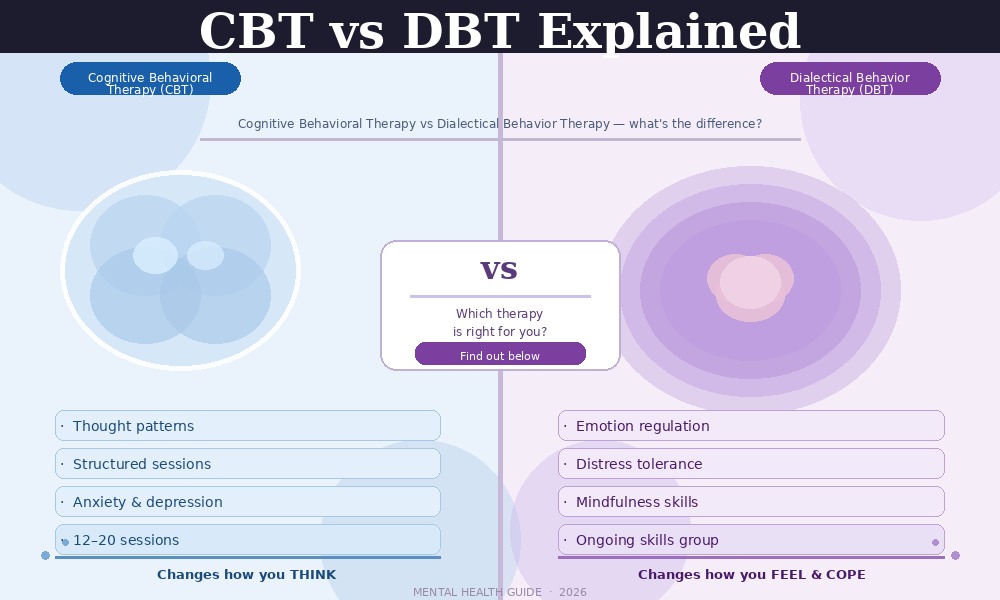
CBT is structured and goal-oriented. Sessions often involve homework — journaling, thought records, behavioral experiments — and the overall course of treatment is usually time-limited, often 12–20 sessions. That structure is part of what makes it effective, but it’s also worth noting: it works best when the person is reasonably stable and able to engage with the cognitive work.
What Is DBT?
Dialectical Behavior Therapy was developed by psychologist Marsha Linehan in the late 1980s, specifically for people with borderline personality disorder — particularly those who experienced intense emotional dysregulation and had not responded well to standard CBT.
The “dialectical” in DBT refers to the balance between two seemingly opposite ideas: acceptance and change. DBT teaches you to accept yourself and your current situation fully while also working to change behaviors that aren’t serving you. It’s this tension — holding both truths at once — that sits at the core of the approach.
DBT has four core skill modules:
Mindfulness — learning to observe your thoughts and feelings without immediately reacting to them. This is the foundation that all the other skills build on.
Distress Tolerance — strategies for getting through a crisis without making the situation worse. This includes techniques like the TIPP skill (Temperature, Intense exercise, Paced breathing, Progressive relaxation) and self-soothing methods.
Emotion Regulation — understanding the function of your emotions and developing tools to reduce their intensity or duration when they become overwhelming.
Interpersonal Effectiveness — building the ability to ask for what you need, say no, and maintain relationships while also maintaining your self-respect.
Full DBT usually involves individual therapy, a weekly skills group, and phone coaching for crisis moments — a more intensive structure than standard CBT.
CBT vs DBT: The Core Differences
The two approaches share some DNA — both are behavioral, skills-based, and heavily researched — but they diverge in important ways.
| CBT | DBT | |
|---|---|---|
| Focus | Changing thought patterns | Managing emotional intensity + behavior |
| Structure | Time-limited (12–20 sessions) | Longer-term, multi-component |
| Best for | Anxiety, depression, OCD, PTSD | Emotional dysregulation, BPD, chronic suicidality, eating disorders |
| Core skill | Cognitive restructuring | Mindfulness + distress tolerance |
| Approach | Change-focused | Acceptance + change balanced |
The simplest way to think about it: CBT helps you think differently. DBT helps you feel and cope differently.
Which One Is Right for You?
This is where it gets personal, and it’s genuinely worth spending time on — because the right match makes a real difference in outcomes.
CBT tends to work well if:
You’re experiencing anxiety symptoms like excessive worry, panic attacks, social anxiety, or health anxiety. CBT has an exceptionally strong evidence base for anxiety disorders and is often the first-line recommendation from clinical guidelines worldwide.
You’re managing mild to moderate depression — especially depression that’s linked to specific negative thought patterns or life circumstances, rather than severe, chronic, or treatment-resistant depression.
You want a structured, problem-focused approach with a clear endpoint. Some people find CBT’s homework-based, analytical style highly compatible with how they naturally process things.
Your distress, while real and significant, doesn’t involve frequent crises, self-harm urges, or intense emotional swings that feel completely out of control.
DBT tends to work well if:
Your emotional experiences feel intense and very difficult to regulate — you go from zero to overwhelmed quickly, and calming down takes a long time.
You’ve struggled with self-harm, suicidal thoughts, or other impulsive behaviors that feel like attempts to cope with unbearable feelings.
You have a diagnosis of borderline personality disorder, or you relate strongly to descriptions of it even without a formal diagnosis.
You’ve tried CBT before and found that you understood the concepts intellectually but couldn’t apply them in the heat of an emotional moment — DBT’s skills are specifically designed for those moments.
You also struggle significantly in relationships — with intense fear of abandonment, conflict patterns that damage connections, or difficulty expressing your needs without it escalating.
It’s worth noting that this isn’t entirely either/or. Many therapists are trained in both and will integrate techniques from each based on what a particular client needs. The labels matter less than finding a clinician who understands your specific presentation.
Recognising Anxiety Symptoms and Signs of Depression
Before you can choose the right therapy, it helps to have a clearer picture of what you’re actually dealing with. Many people seek help for one thing and discover their experience is more complex — and that’s completely normal.
Common anxiety symptoms include:
- Persistent, excessive worry that’s hard to control
- Physical tension, restlessness, or feeling on edge
- Sleep difficulties — trouble falling or staying asleep
- Difficulty concentrating
- Avoiding situations that trigger anxiety (social events, medical appointments, work tasks)
- Panic attacks — sudden intense fear with physical symptoms like racing heart, shortness of breath, and dizziness
Common signs of depression include:
- Persistent low mood or emptiness most of the day, most days
- Loss of interest in activities that used to feel enjoyable
- Changes in sleep — sleeping too much or too little
- Fatigue and low energy that doesn’t lift with rest
- Feeling worthless, guilty, or hopeless
- Difficulty thinking, concentrating, or making decisions
- Thoughts of death or suicide
If any of this resonates and you haven’t spoken to a mental health professional yet, it’s worth doing. The National Institute of Mental Health has clear, evidence-based information on both conditions if you want to read more before reaching out.
Online Therapy and Teletherapy: What’s Changed
Access to mental health therapy has shifted considerably over the past few years. Online therapy — delivered via video call, messaging, or phone — has become genuinely mainstream, and for many people, it’s removed barriers that used to make getting help very difficult.
The most widely used teletherapy apps and platforms in the US currently include:
BetterHelp — matches you with a licensed therapist based on your needs; messaging, video, and phone sessions available. Good for anxiety and depression, though not suitable for severe mental illness or crisis situations.
Talkspace — similar model, with additional options for psychiatry and medication management alongside therapy.
Cerebral — focuses more on medication management and is particularly well-regarded for ADHD and depression treatment.
Brightside — specifically designed for depression and anxiety, with a combination of therapy and medication if needed.
Psychology Today’s therapist finder (psychologytoday.com) — not an app as such, but an excellent directory for finding in-person or telehealth therapists who specialise in CBT or DBT specifically, filterable by insurance and location.
A 2024 meta-analysis published in the Journal of Medical Internet Research found that online CBT was as effective as face-to-face CBT for anxiety and mild-to-moderate depression — a finding that’s meaningfully changed how clinicians think about telehealth as a first-line option rather than a compromise.
Stress Management Tips That Work Alongside Therapy
Therapy — whether CBT, DBT, or another approach — works faster and more deeply when paired with daily stress management habits. These aren’t substitutes for professional support, but they’re evidence-backed practices that genuinely complement the clinical work.
Regular physical movement. Exercise has one of the strongest evidence bases of any non-pharmacological intervention for anxiety and depression. It doesn’t need to be intense — 30 minutes of walking five days a week produces measurable improvements in mood and anxiety levels, according to research cited by the American Psychological Association.
Sleep consistency. Both CBT and DBT work better when you’re not sleep-deprived. Keeping a regular sleep and wake time — even on weekends — is one of the most impactful things you can do for mental health baseline.
Limiting alcohol. Alcohol is a depressant and significantly disrupts sleep architecture, even in moderate amounts. Many people use it as a stress management tool without realising it’s making both anxiety and depression harder to treat.
Social connection. Isolation amplifies nearly every mental health difficulty. Even low-effort connection — a brief text exchange, a walk with a friend — has a measurable effect on mood.
Mindfulness practice. Even outside of DBT, a basic mindfulness practice — 10 minutes daily of focused breathing or body scan — reduces anxiety and emotional reactivity over time. Apps like Headspace and Insight Timer make this accessible without any cost.
Finding the Right Therapist
Knowing which therapy you want is only half the equation. Finding a therapist who is trained in it and who you feel comfortable with is the other half.
When searching for a CBT or DBT therapist:
Ask directly whether they are trained in CBT or DBT — many therapists describe themselves as “eclectic,” which isn’t necessarily bad, but if you specifically want structured CBT or full DBT, you want someone with specific training in that approach.
For DBT especially, look for therapists who offer the full model (individual therapy plus skills group) rather than just “DBT-informed” therapy, which may mean they use some techniques without the complete structure.
Check insurance coverage before your first session. The Health Insurance Marketplace requires most plans to cover mental health services at the same level as physical health — but what’s covered varies by plan and provider.
If cost is a barrier, community mental health centers, university training clinics (where supervised graduate students provide therapy at reduced cost), and sliding-scale practices are all legitimate options worth exploring.
A Realistic Expectation-Setting Note
Both CBT and DBT take time. Neither produces results in one or two sessions. Most people start noticing real changes after four to six weeks of consistent work — and the skills become more natural with practice, not just in sessions but in the actual moments of daily life when they’re needed most.
The research on both is genuinely encouraging. A significant majority of people who complete a full course of CBT for anxiety or depression show substantial improvement. DBT has transformed outcomes for people with borderline personality disorder and chronic suicidality — populations that previously had very limited effective treatment options.
The decision to start is the most important one. Everything after that is refinable.
References: NIMH — Depression | APA — Exercise and Stress | Verywell Mind — CBT Guide | Psychology Today — DBT | Healthline — Online Therapy
